
Review · MAUI RAFTING TOURS
Whale Watching Maui: 2-Hour Small Group Raft Tour from Lahaina
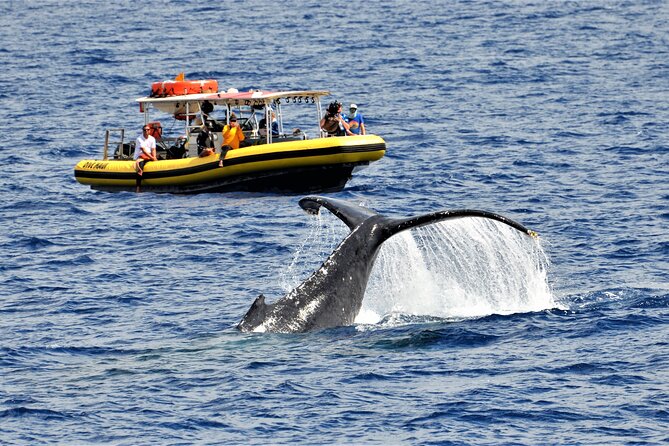
The best part of this Lahaina whale trip is the low, open raft, which puts you close to the water with clear views in nearly every direction. You may watch mothers and calves, see a young whale practicing breaches, or hear singing through the onboard hydrophone.
I like the small-group setup and the crew’s focus on teaching, not just pointing at a distant spout. Captains Will and Joe, along with naturalists Renee and Brian, have earned praise for finding active pods and explaining what you are seeing. Filtered water, paper cups, reef-safe sunscreen, and rain ponchos are thoughtful touches.
The catch is simple: wild whales set the schedule. The whale guarantee means another trip or a refund arrangement if no whales are seen, but it does not promise breaching, close approaches, or nonstop action. Rough weather can also cancel the outing.
Key points to know before booking
- Small raft, broad views: The custom inflatable boat provides 360-degree sightlines, and the maximum group size is 20.
- Whale songs included: A hydrophone and speakers let you hear humpback calls beneath the boat.
- Strong naturalist element: The crew explains whale behavior, mothers and calves, escort males, and the Maui Nui sanctuary.
- Two hours on the water: That is enough time to search several areas without taking up your whole day.
- Whale sighting guarantee: If the trip does not find whales, you can take another trip free, according to the tour terms.
- Important restrictions: Children under 3 and pregnant people cannot join. Alcohol is allowed only if brought in a container with no glass.
Leaving Lahaina for Maui’s winter whales
This tour begins at 1223 Front Street in Lahaina and returns to the same meeting point. The location makes it easy to fit the outing into a day based around Lahaina, though you should allow time to check in before departure and avoid scheduling a tight appointment right afterward.
The season matters. Humpback whales migrate to the warm waters around Maui during winter to mate and give birth. The Maui Nui whale sanctuary, between Maui, Lanai, Molokai, and Kahoolawe, gives the whales a protected area where they gather in large numbers.
You are not heading to a fixed exhibit or feeding site. The captain searches for whales in open water, using reports of activity and what appears on the horizon. That makes each two-hour trip different. One outing may bring mothers and calves near the raft, while another may involve patient scanning followed by a few rewarding sightings.
I like this approach because it keeps the animals in charge. The crew can move toward whales and position the raft, but nobody can order a humpback to breach on cue. The company guarantees a whale sighting, not a specific kind of show.
More Whale Watching Trips in the USA:
- Maui Whale-Watching Tour by Raft from Kihei
★ 5.0 · 646 reviews - Zodiac Raft Whale Watching Adventure
★ 5.0 · 456 reviews - HIGH QUALITY Whale Watch Adventure Aboard Luxury Super Raft
★ 5.0 · 142 reviews
Why the yellow raft changes the view
A large boat gives you more room, but this raft offers a different kind of ride. With a maximum of 20 people, and sometimes fewer, you are less likely to have a wall of passengers blocking your view. One group reported only eight people aboard, which made the boat feel especially open.
The raft’s design gives you sightlines around both sides and toward the bow and stern. That matters when whales surface unpredictably. You can turn quickly instead of waiting for a crowded deck to clear.
The boat also sits close to the water. That can make a nearby whale feel more immediate, especially when a humpback surfaces beside or under the raft. At the same time, a low boat can feel more exposed to spray and chop than a large vessel. If you are prone to motion sickness, consider that before choosing this format.
Small does not mean the boat may approach without limits. Hawaii’s whale-watching rules apply to every operator, and the raft must keep the required distance. Its advantage is maneuverability and visibility, not permission to crowd the animals. The whales decide how close they come.
Searching the sanctuary with a captain and naturalist
Once away from shore, the captain scans for blows, tails, breaches, and groups on the surface. The naturalist adds the context that turns a quick sighting into a useful lesson.
You might see a mother with her calf and an escort male nearby. The escort is often competing for access to the female, which can produce active behavior and sudden changes in direction. A young whale may slap its tail, roll, or work through the early stages of breaching.
Captains Will and Joe have been singled out for positioning the boat well while keeping clear of the whales. Naturalists Renee and Brian have been praised for answering questions and explaining the animals in plain language. Crew assignments can vary, but the trip is built around having both a captain and a marine naturalist onboard.
This combination is one of the tour’s strongest features. A captain who can react quickly helps you spend less time motoring toward an empty patch of water. A good naturalist helps you understand why the whale is behaving as it is, rather than reducing the outing to a hunt for the next splash.
Still, you should expect some quiet periods. Whale watching involves looking across a broad stretch of ocean and waiting for the next blow. Bring patience and keep your eyes moving. The reward may be a single tail at first, followed by a mother and calf surfacing several times.
Hearing humpback songs below the raft
The hydrophone is more than a small extra. It lets the crew place an underwater microphone in the sea and send the whales’ sounds through speakers on the raft.
Humpback song is especially striking because you hear it while the animal remains out of sight. The sound adds another layer to the trip: you are not only watching blows and tails, but also listening to what is happening beneath the surface.
The timing depends on conditions and whale activity. The hydrophone does not guarantee a constant soundtrack, and the ocean can be noisy. When the crew lowers it and the songs come through clearly, though, it can become one of the most memorable parts of the two hours.
I would pay attention to the naturalist’s explanation here. The value is not just hearing an unusual sound. It is understanding that the whales’ world continues below the surface even during the pauses when you see nothing.
More Two-Hour Experiences in the USA:
- 2 Hour Rafting on the Yellowstone River
★ 5.0 · 549 reviews - Maui Eco-Raft: 2 Hour Dolphin Watch Sightsee Tour (Semi-Private)
★ 5.0 · 95 reviews - Jasper National Park: 2-Hour Whitewater Rafting
★ 4.9 · 310 reviews - Jasper: Jasper National Park Easy 2-Hour Rafting Trip
★ 4.8 · 291 reviews
What the two-hour schedule feels like
The advertised duration is about two hours, with the activity ending back at the Lahaina meeting point. That length works well for families with older children, couples, and anyone fitting whale watching around other Maui plans.
The outing generally has a simple rhythm:
- Check in at the Front Street meeting point.
- Board the custom inflatable raft.
- Travel out toward the Maui Nui sanctuary.
- Search for blows and active groups.
- Pause to watch behavior and hear the hydrophone.
- Return to Lahaina after roughly two hours.
The time can pass quickly once the whales appear. A group may spend several minutes watching one mother and calf, then relocate to another area where more activity is taking place. Some outings have included more than a dozen whales, while others have been less dramatic.
That variation is worth considering at the booking stage. The whale guarantee protects you from ending the trip without a sighting, but it does not ensure the same level of activity on every date. If seeing a breach is your main goal, leave room in your schedule for a second attempt rather than treating one trip as a guaranteed wildlife performance.
Small details that make the trip easier
Filtered water and paper cups are included, which reduces the need for single-use plastic bottles. Reef-safe sunscreen is also provided. That is useful because you will be exposed to sun and reflected glare on open water, though you may still want to bring a hat and sunglasses if those are comfortable and secure.
Rain ponchos are provided on rainy days. Weather can change quickly, and the raft offers less shelter than a larger covered vessel. Dress for spray and shifting conditions rather than assuming a sunny Lahaina morning will last all afternoon.
Alcohol is not included, but you may bring your own. Glass is not allowed. Since this is a moving raft with limited room, keep anything you bring compact and secure.
The activity is family-friendly for children aged 3 and older, but it is not open to children under 3 or pregnant people. Service animals are allowed, and most people can participate. The operator lists a maximum of 20 people, though the actual number may be lower.
Price and value at $80.60
At $80.60 per person, this is priced above some larger whale boats but below many premium marine excursions. The useful comparison is not just the ticket price. You are paying for a two-hour trip, a smaller vessel, a marine naturalist, filtered water, reef-safe sunscreen, and the hydrophone experience.
The raft may provide better sightlines than a crowded upper deck, especially when everyone needs to turn toward a sudden breach. The smaller group also gives you a better chance to ask questions and hear the naturalist without competing with a large crowd.
That premium does not guarantee closer whales. All operators must follow the same whale-protection rules, and some days the whales remain at a distance. If the animals are inactive, the smaller boat cannot manufacture excitement. A larger, less expensive tour may offer a similar view on that particular day.
For me, the price makes the most sense if you value a quieter group, a low position on the water, and interpretation from the crew. It makes less sense if you only want the cheapest possible way to scan the ocean for a whale tail.
The 98 percent recommendation rate and 4.9 rating from 661 ratings indicate very strong overall satisfaction, but no wildlife outing is perfect. One detailed complaint focused on the lack of added closeness compared with larger boats. That concern is fair, and you should book with realistic expectations about legal distance and animal behavior.
Weather, cancellations, and a sensible backup plan
This trip requires good weather. High wind and waves can lead to cancellation, sometimes on short notice. That is frustrating when whale watching is a major part of your Maui plans, but a small open raft should not go out in conditions that make the ride unsafe.
If the operator cancels for poor weather, you are offered another date or a full refund. You can also cancel for a full refund up to 24 hours before the start time. Cancellations or changes made within 24 hours are not accepted for a refund.
I would schedule this near the beginning of your Maui stay if whale watching is important to you. That leaves time for another attempt if weather cancels the first trip, and it gives you a better chance to use the free repeat option if no whales are found.
Who will enjoy this raft most
This outing suits you if you want an intimate wildlife trip rather than a large, formal boat ride. Couples and friends can enjoy the open views, while families with children aged 3 and older may appreciate the short two-hour format.
It is also a good match for people who want to learn. The naturalist does more than announce a sighting. You can ask about mothers, calves, escort males, migration, and the sounds coming through the hydrophone.
You should think twice if you dislike bouncy boats, have limited tolerance for sun and spray, or need a covered, stable deck. The tour information says most people can participate, but it does not describe a fully sheltered vessel or a smooth ride in rough conditions.
Photography can be rewarding, but wildlife is unpredictable. Keep your camera ready, yet do not spend the entire trip looking through a screen. The best sightings may last only a few seconds, and the raft’s 360-degree views are more useful when you are watching the whole surface.
Should you book the Lahaina small-group raft?
I would book this tour if you want a well-guided whale search with a small group, good sightlines, and the chance to hear humpback songs. The crew’s strongest qualities are their enthusiasm, their ability to explain whale behavior, and their effort to position the raft without interfering with the animals.
I would not book it solely because you expect whales to swim directly beneath the boat or perform on demand. That can happen, and some outings have included playful calves, competing males, and repeated close-looking encounters. It is not promised.
At $80.60, the tour earns its price when the smaller raft and personal instruction matter to you. Choose a larger boat if saving money and having more shelter matter more. For a flexible visitor in Maui during whale season, this is a strong choice, especially if you can leave room in your schedule for weather or a second outing.
FAQ
Where does the whale watching tour begin and end?
It begins and ends at 1223 Front Street in Lahaina, Hawaii. The activity returns to the same meeting point.
How long is the whale watching trip?
The trip lasts approximately two hours.
What is included?
Filtered water, paper cups, reef-safe sunscreen, a whale-loving marine naturalist, and a hydrophone with speakers for hearing whale songs are included. Rain ponchos are provided on rainy days.
How many people can join the raft?
The maximum group size is 20 people. The actual group may be smaller.
Are children and pregnant people allowed?
Children under 3 are not allowed, and pregnant people cannot participate. Most other people can participate, and service animals are allowed.
What happens if the weather cancels the tour or no whales are seen?
If poor weather causes a cancellation, you will be offered another date or a full refund. If no whales are seen, the tour offers another trip free. You can cancel at least 24 hours before the start time for a full refund.
Just added around the USA
- From Gardiner: Yellowstone River Whitewater Rafting & Lunch★ 4.9 · 20 reviews
- Gardiner: Full Day Raft Trip on the Yellowstone River+Lunch★ 5.0 · 3 reviews
- Gardiner: Half-Day Whitewater Raft Trip on the Yellowstone★ 5.0 · 24 reviews
- Gardiner: Scenic Raft Float on the Yellowstone River★ 5.0 · 4 reviews
- Moab: Full-Day Colorado Rafting Tour★ 5.0 · 16 reviews
- From Seward: Resurrection River Rafting Tour★ 4.7 · 5 reviews
- From Moab: Cataract Canyon Whitewater Rafting Experience★ 4.4 · 2 reviews
- From Las Vegas: Hoover Dam Raft Tour★ 3.8 · 28 reviews
Maui Rafting Tours, compared.
Maui to Lanai Semi-Private Eco Raft Snorkel & Dolphin Tour
Read our review →
HIGH QUALITY Whale Watch Adventure Aboard Luxury Super Raft
Read our review →
Maui Eco-Raft: 2 Hour Dolphin Watch Sightsee Tour (Semi-Private)
Read our review →Other lists this trip is on